
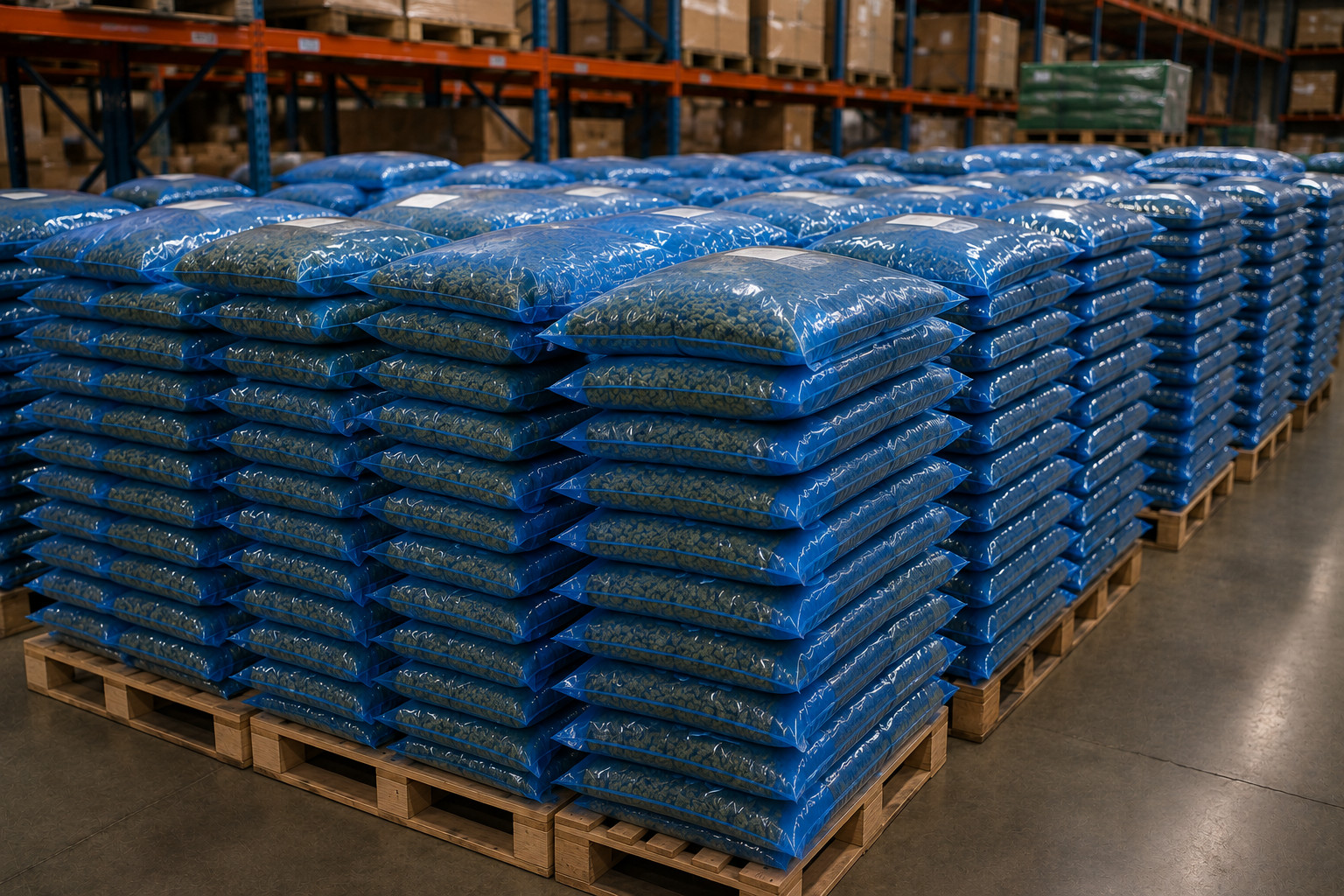
A dehydrated ingredient is only as good as the packaging that protects it. The 5-percent moisture content that defines a dried product can drift back upward in transit if the pack is permeable, the seal is poor, or the warehouse is wrong. A specification that was perfect when the lot was released can fail by the time it reaches the customer's intake bay, with no fault on either side except the system in between.
Industrial packaging for dehydrated ingredients is therefore a discipline in its own right, not an afterthought. The choices about what material, how to seal it, how to palletise it, and how to store it before container loading are the difference between a stable product that arrives on specification and one that does not.
This article explains the double-bag system we use at Healthy Foods Egypt, the pallet discipline behind it, the warehouse conditions that complete the chain, and the sourcing questions a buyer should ask before approving a new dehydrated-ingredient supplier.
Key Takeaways
- The dehydrated product is sealed in an air-tight polyethylene inner bag, then placed inside a multi-walled paper bag or carton.
- Inner bags are heat-sealed or zip-tied; outer cartons are taped and labelled.
- Pallets are plastic and held above the floor; finished goods never touch unsealed surfaces.
- The warehouse holds humidity at or below 65 percent across an 11,000 square metre facility with controlled climate and air recycling.
- A bar-coding system gives lot-level traceability and inventory accuracy.
Why Packaging is Half the Product
Moisture is the enemy of a dried product. Every percentage point of moisture above the specification target makes the ingredient more vulnerable to microbial growth, fungal load, caking, and shelf-life loss. The packaging is therefore not just a container; it is the moisture barrier that keeps the product at specification from the day it leaves the dryer to the day it enters the customer's process.
Packaging also carries the lot identification, traceability, and certification metadata. A bar-coded outer bag with proper labelling lets the customer's incoming inspection identify what they received and trace it back to a production lot if anything questions arise. Without that traceability, a complaint becomes an investigation with no clear path forward.
Beyond moisture and traceability, packaging defines how the product is handled in transit. A bag that is well-built, well-sealed, and palletised properly survives container loading, ocean transit, port handling, and unloading without damage. A bag that fails any of these tests gets the customer involved in re-bagging, re-sampling, or re-issuing claims, and the supplier relationship suffers regardless of who was technically at fault.
The Double-Bag System Explained
Healthy Foods Egypt packs every form of every product in a double-bag system: an air-tight inner polyethylene bag plus a robust outer protective layer. The combination is deliberate: the polyethylene seals the moisture boundary and the outer material handles physical protection in transit and warehouse.
Inner: Sealed Polyethylene
The inner polyethylene bag is the moisture barrier. It is food-grade polyethylene, sized to the product fill, and either heat-sealed or zip-tied closed to give an air-tight seal. The film thickness and properties are chosen to balance puncture resistance with sealability. The point of the inner bag is to prevent any exchange of moisture between the product and the surrounding environment for the duration of the supply chain, including any periods of high humidity at port or in transit.
Outer: Multi-walled Carton
The outer layer is a multi-walled strong carton box. The job of the outer layer is physical protection: handling forces, stacking weight, transit abrasion. Multi-walled paper bags are typical for the largest pack weights and the bulkier cuts; cartons are used where stacking precision and unit handling are more important. Labelling is applied to the outer layer, including lot identification, product code, package weight, production date, and certification metadata.
Sealing Methods
Inner bags are either heat-sealed or zip-tied closed. Heat sealing creates a continuous, permanent seal across the bag opening and is the preferred method for full-fill bags. Zip-tying is used where a customer requires a re-openable closure, typically for sampling purposes during incoming inspection. Both methods are validated and inspected as part of the line's quality programme.
Pallet Discipline
Sealed bags are stacked on plastic pallets, not wooden ones. Plastic pallets are easier to clean, do not harbour pests, do not absorb moisture, and meet international phytosanitary standards (ISPM 15) without fumigation. Pallets are stacked in configurations that match the customer's container loading plan and labelled at the pallet level for traceability.
Finished goods never touch unsealed surfaces. Pallets are kept above the floor, separated from incoming raw materials, and held in dedicated finished-goods bays in the warehouse. The bar-coding system tracks every pallet from packaging through to dispatch, with daily inventory reconciliation against the production records.
Warehouse Conditions
The packaging system works alongside the warehouse, not independently. The warehouse runs across an 11,000 square metre facility with humidity controlled at or below 65 percent, an air-recycling system that prevents stagnation, controlled climate to prevent thermal stress on packaging, and a light-controlled environment that limits photodegradation of colour and aroma compounds. Pest control is conducted periodically with documented sign-off, and physical barriers (door closers on all doors, insect screens on all windows) are inspected as part of the standard hygiene programme.
- Footprint: 11,000 square metres.
- Humidity ceiling: at or below 65 percent.
- Air handling: recycled, with no stagnation.
- Light exposure: controlled to limit photodegradation.
- Pallet standard: plastic, held above the floor.
- Traceability: bar-coded at the lot level, with daily reconciliation.
- Pest barriers: door closers on all doors, insect screens on all windows.
Together, the packaging and the warehouse conditions form a single chain. Either element on its own is insufficient; both together protect the specification from the day of release to the day of use.
Container Loading & Global Shipping
Finished pallets are loaded into containers in patterns optimised for either the customer's destination dock layout or the carrier's preference. The bar-coding system records the loading sequence, which becomes the basis of the packing list and the bill of lading. Each container ships with full documentation: certificate of analysis, certification copies, packing list, and any market-specific declarations (organic, halal, kosher, irradiation declaration where applicable).
A 20-foot container typically carries one set of pallet configurations, a 40-foot container another. The exact figures depend on the product family and the form, and are confirmed at the quotation stage so the buyer can plan container charge, customs clearance, and intake-bay capacity ahead of arrival.
Shelf-life Math: How Packaging & Storage Protect Microbiology
The microbial limits that a dehydrated-ingredient specification names depend on moisture being held at or below the 5-percent target. Above that target, microbial and fungal growth accelerate quickly. The double-bag packaging system holds the moisture boundary, the warehouse conditions hold the climate, and together they protect the microbiological profile for the duration of the supply chain.
Shelf life for properly-packaged dehydrated allium and herb ingredients held in proper conditions runs to 18 to 24 months in most cases. Specific shelf-life statements are confirmed per product on the certificate of analysis, and longer storage windows can be supported with periodic re-testing if the customer's warehouse conditions are equivalent to ours.
Packaging holds the moisture boundary. The warehouse holds the climate. Lose either and the specification fails.
A Sourcing Checklist
When evaluating a dehydrated-ingredient supplier on packaging, run through these questions:
- Is the inner bag polyethylene and air-tight? Is sealing method specified (heat-sealed or zip-tied)?
- Is the outer layer multi-walled paper or carton with clear labelling?
- Are pallets plastic, above the floor, and labelled at the pallet level?
- Is the warehouse humidity controlled at or below 65 percent?
- Is climate and light controlled, with air recycling rather than stagnation?
- Are pest barriers in place, with periodic pest-control documentation?
- Does the supplier provide bar-coded lot-level traceability across the production record?
- Are container loading patterns and packing lists available at the quotation stage?
A supplier that answers cleanly on all 8 points has the packaging discipline to keep specification through the supply chain. A supplier that hedges on any of them carries hidden risk that surfaces later.
Pack Weights & Configuration Choices
The choice of pack weight is a deliberate decision rather than a default. Industrial dehydrated allium and herb ingredients are typically packed in 10, 15, 20, or 25 kilogram units, with the choice driven by how the buyer's process consumes them, by handling ergonomics at the receiving dock, and by the way pallets stack inside containers.
A blender running large batches usually prefers 20 or 25 kg bags because each addition is a single bag rather than several smaller ones, and the bag handling rate scales accordingly. A line dosing a finer recipe with smaller per-batch additions often prefers 10 or 15 kg bags because they are easier to lift, easier to handle into a hopper, and produce less single-bag waste when a partial addition is needed.
The per-product norm at Healthy Foods Egypt follows the company-profile catalogue. For dehydrated onion: 20 kg for diced, slices, bold cut, kibbled, chopped, and minced grades; 20 to 25 kg for granules and powder; 10 to 20 kg for minced grades on request. For garlic: 20 kg for chopped, minced, granules, and flakes; 20 to 25 kg for powder. For leek: 15 kg for flakes and granules; 25 kg for powder. For herbs and aromatic seeds: 10 to 20 kg for the leafy herbs; 25 kg for seeds. The exact configuration is confirmed at the quotation stage so the buyer can plan dock handling.
What Can Go Wrong: Failure Modes in the Chain
Packaging and storage systems fail in characteristic ways, and understanding the failure modes is the best way to specify against them. The most common failures are:
- Seal failure on the inner polyethylene bag. A poorly heat-sealed seam or a damaged zip tie creates a path for moisture exchange. Visual inspection of seals at the packaging line is the primary defence; sampling and seal-strength testing form the verification chain.
- Outer-bag rupture in transit. A multi-walled paper bag can split if pallet stacking is wrong, if the unit weight is at the limit of the bag's design, or if handling at port is rough. The defence is correct bag specification and pallet-stack patterns matched to handling routes.
- Humidity excursion at port or in transit. A container left in tropical port conditions for several days can experience high humidity and temperature swings. The defence is the inner polyethylene bag, which carries the moisture barrier; the outer bag should not be the moisture barrier on its own.
- Pallet damage at intake. Plastic pallets resist most handling damage but can crack under extreme point loading; mixed pallet types in a buyer's warehouse can also create rotation challenges. The defence is consistent pallet specification across shipments.
A buyer running an incoming inspection programme is essentially looking for these failure modes at the receiving dock. A shipment where all 4 are absent is a shipment the buyer can release straight to production.
From Dispatch to Intake: What the Buyer's QA Sees
When a container arrives at the buyer's intake bay, the QA team typically runs through a sequence of checks before releasing the product to production. Documentation comes first: certificate of analysis, certifications applicable to the order, packing list, bill of lading, and any market-specific declarations. The check confirms that the documents match what was ordered and that nothing has been lost in transit.
Visual inspection of the pallets comes next: pallet integrity, bag condition, labelling correspondence between outer bags and the packing list. Samples are pulled from a defined number of bags per lot, typically following an AQL sampling plan, and brought to the buyer's incoming-inspection laboratory. The laboratory runs against the buyer's specification, which should match the supplier's certificate of analysis within analytical tolerance.
Where the buyer's results and the supplier's certificate disagree, the resolution path runs through the documented sampling and testing procedures. A reproducible disagreement usually triggers a supplier conversation; a one-off divergence within analytical tolerance is typically dismissed. The verification chain we run, in-house plus accredited external lab, is designed to make these disagreements rare and resolvable.
Sustainability Considerations in Packaging
A growing share of buyer specifications now include sustainability requirements alongside the food-safety requirements. The most common are recyclability of the packaging materials, recycled content in the outer layer, certification of the wood-fibre source (FSC or equivalent) for paper components, and minimisation of plastic content overall.
Our standard double-bag system uses food-grade polyethylene for the inner bag (recyclable, food-contact compliant) and multi-walled paper or carton for the outer (recyclable, with FSC-certified options available on request). The plastic content is held to what is needed for the moisture barrier; the outer protection is fibre-based. Where a buyer specifies additional sustainability requirements, we discuss them at the quotation stage and confirm the implications for cost, lead time, and certification documentation.
Where Is The Packaging System Heading?
Looking forward, 2 trends will shape industrial dehydrated-ingredient packaging over the next several years. The first is the EU's Packaging and Packaging Waste Regulation, which is tightening recyclability requirements and minimum recycled-content thresholds across European packaging. The second is the growing prevalence of buyer-led private sustainability standards layered on top of the regulatory baseline, particularly from major retailers and large food manufacturers with their own published environmental targets.
Both trends point in the same direction: less plastic where it is not strictly needed for food safety, more recycled and recyclable fibre in the outer layer, more rigorous documentation of the packaging supply chain (including the supplier-of-the-supplier for the raw packaging materials), and more frequent change management as the standards evolve. A supplier that can adapt its packaging system without compromising the moisture barrier and the seal integrity is a supplier that can stay aligned with these standards as they tighten.
For our part, we keep the moisture barrier as the unchanging core of the packaging system (because losing it would invalidate the microbiological commitment) and adapt the outer protection and labelling to fit the evolving buyer requirements. The fundamentals do not change; the periphery does, in conversation with each buyer's purchasing and sustainability teams. Buyers running such programmes typically share their requirements at the quotation stage so that the supplier can confirm operational feasibility before commitment.
Further Reading
For the microbiological side that the packaging protects, see how to read a microbiological specification. For the production process behind every lot, see inside the 14-step process flow. The full warehouse and storage programme is documented on the quality hub.
Bringing it Together
Packaging is not a wrapper. It is the moisture boundary that protects the specification, the labelling that carries the traceability, and the unit of handling that determines whether the shipment arrives intact. Pallet discipline keeps finished goods off the floor and traceable; warehouse conditions keep the climate stable. Together, they form the chain that protects everything upstream of them.
To open a quotation that includes per-product packaging and minimum-order details, request a quote and a regional sales lead will respond within one business day. To visit the warehouse and packaging area in person, contact us to arrange an audit window.