
A microbiological specification looks intimidating to a casual reader. Long lists of organisms, technical names, exponential limits, and footnotes about sample weights. To a buyer or quality team, though, every line on the sheet answers a specific question about how the ingredient was grown, processed, and handled. The numbers are not arbitrary, and reading them properly is the first audit an experienced buyer runs on a new supplier.
This guide walks through the standard rows on a dehydrated-ingredient microbiological specification. It explains what each organism indicates, how to interpret a limit, and how to separate a serious commitment from a marketing claim. It uses our own commitment as a worked example, but the framework applies to any supplier you are evaluating.
If you read nothing else, read the key takeaways below. The detail beneath them is for the times when you want to go deeper.
Key Takeaways
- Microbiological limits are not pass-fail thresholds chosen at random. Each one tells a quality team something specific about how the ingredient was made.
- Total plate count reflects overall microbial load; indicator organisms reflect hygiene; pathogens such as Salmonella must be absent in a defined sample weight.
- A meaningful specification is verified by both an in-house and an accredited external laboratory, not asserted on a brochure.
- Pesticide and heavy-metal compliance with European Union legislation belongs alongside microbiology in the specification.
- Across our catalogue we commit to a single, uniform set of limits, so qualifying one form qualifies the supplier broadly.
Why Microbiology is the First Thing a Buyer Audits
Industrial buyers care about microbiology because a contaminated ingredient creates a cascade of expensive problems. A recipe formulated around an ingredient that drifts in microbial load becomes unpredictable. A shipment that fails incoming testing has to be quarantined, re-sampled, and either reworked or rejected, all of which costs time and storage. A finished product that fails downstream because of an ingredient is the worst outcome: a recall, a brand impact, and a complete review of the supply base.
The point of a microbiological specification is to make that risk auditable up front. It defines what the supplier commits to deliver, lot by lot. It defines what the buyer's incoming team can test against on arrival. And it defines what the regulator or the brand auditor will see when they review the documentation. If the numbers do not match the application, the relationship cannot work, and the conversation should happen before purchase orders, not after.
The Vocabulary, Line by Line
Most dehydrated-ingredient specifications are organised the same way. There is a moisture target, an overall microbial-load measurement, a set of indicator organisms, the pathogen tests, the yeasts and moulds figures, and one or more sample-weight footnotes that define how the test is conducted.
Total Plate Count (TPC)
TPC, sometimes shown as APC or aerobic plate count, is the total number of viable aerobic microorganisms recovered from a sample under specified conditions. It is not a safety test on its own, but it is the most informative single number on the sheet because it indicates overall microbial load. A high TPC suggests poor process control, inadequate drying, or contamination somewhere in the production chain. A low TPC suggests a clean, controlled process, but only when the rest of the numbers agree.
Indicator Organisms
Indicator organisms such as Escherichia coli, coliforms, and Enterobacteriaceae are not pathogens in themselves at the levels reported on a dehydrated-ingredient sheet, but their presence indicates faecal contamination, hygiene lapses, or post-process recontamination. A buyer reads them as a window into how the production line is operated. Low limits across all 3 indicate disciplined hygiene; elevated counts indicate a problem somewhere in the chain.
Pathogens
Pathogens such as Salmonella are tested for as absent in a defined sample weight, not as a maximum count. The convention for dehydrated ingredients is absence in 25 grams, which reflects the regulatory expectation for ready-to-eat food ingredients and the analytical sensitivity of the standard test method. A pathogen specification that does not name a sample weight is not a meaningful specification.
Yeasts & Moulds
Yeasts and moulds reflect how well moisture and storage have been managed. A dried product with elevated moisture, poor packaging, or inadequate warehouse humidity control will accumulate fungal load quickly. Low limits indicate a clean drying and warehousing process; high limits indicate problems further down the chain.
Moisture & Water Activity
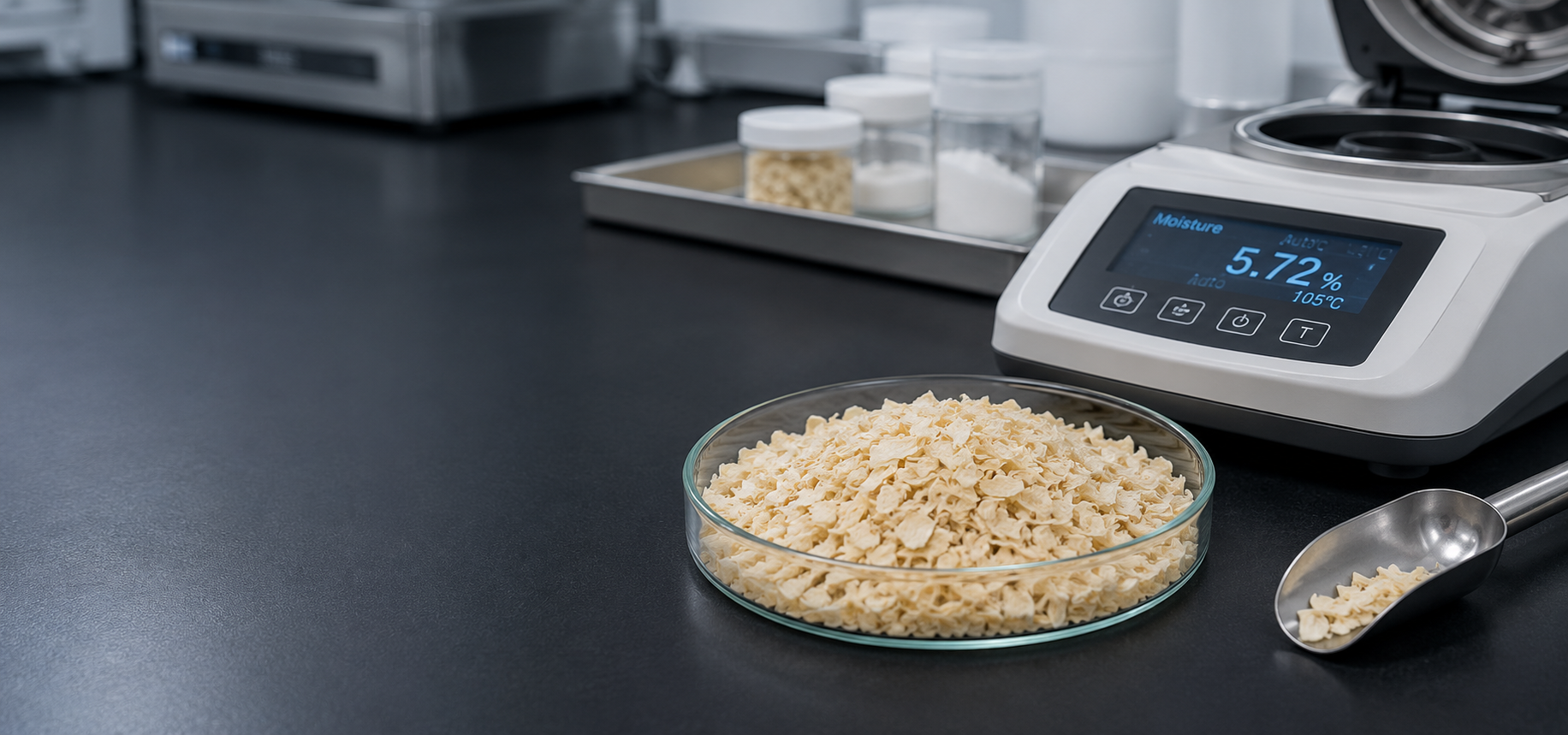
Moisture content is the master variable for everything else on the sheet. Microbial growth, fungal load, and shelf life all depend on it. The standard target for dehydrated allium and herb ingredients is 5 percent moisture. Water activity, the more direct measure of available moisture, sits well below the threshold for microbial growth at that level.
The Numbers We Commit To
Across our catalogue, the targets are consistent: every product family, every form, every grade.
- Moisture content: 5 percent.
- Total plate count (TPC): 100,000 colony-forming units per gram.
- Escherichia coli: 10 colony-forming units per gram.
- Coliforms: 100 colony-forming units per gram.
- Yeasts: 100 colony-forming units per gram.
- Moulds: 1,000 colony-forming units per gram.
- Enterobacteriaceae: 1,000 colony-forming units per gram.
- Salmonella: absent in 25 grams.
Uniform limits make qualification simpler. A buyer who has qualified one of our forms has effectively qualified the supplier, because the same microbiological discipline runs across the dehydration, cutting and granulation, and herbs and spices processing lines.
How The Numbers Get Verified
A commitment is only as good as its verification chain. Every lot of finished product is tested in our in-house laboratory before release. The results are cross-validated by an accredited external laboratory, and the analytical methods used are those of the International Organization for Standardization where applicable. The in-house and external systems together form a check on the system itself, since 2 independent labs operating on aliquots of the same lot should agree within the analytical tolerance of the methods.
The laboratory tests measure particle size, bulk density, total moisture, water activity, metal and magnet integrity (relevant on incoming finished product), pesticide residues, heavy metals, microbiological load (the targets shown above), and cleanliness. The full scope is described on the laboratory pillar of the quality hub.
A specification without a verification chain is a brochure. A specification with one is a contract.
The verification chain is what lets a buyer accept incoming product with confidence and reduces the need for full re-testing on the buyer's own line.
Beyond Microbiology: Residues, Contaminants, and EU Compliance
A complete dehydrated-ingredient specification also names the limits on chemical contaminants. Pesticide residues are controlled to the limits set by European Union legislation, which is the most stringent widely-applied regime in international food trade. Heavy-metal limits follow the same legislation. The compliance statement is part of every product specification we issue, and supporting laboratory documentation is provided with each shipment.
Mycotoxin testing for relevant products, allergen statements, and origin information typically sit on the same specification page. Buyers selling into the European market or to retailers with their own private-label standards usually need all of this in one place; quoting against an incomplete specification leads to delays at the audit step.
A Sourcing Checklist
When evaluating a new dehydrated-ingredient supplier, run through this checklist before signing an order:
- Does the specification name moisture, TPC, indicator organisms, yeasts, moulds, and pathogen tests with limits?
- Does each pathogen specification name a sample weight (typically 25 g)?
- Is the verification chain named, with both in-house and accredited external lab involved?
- Does the supplier provide a pesticide and heavy-metal statement consistent with European Union legislation?
- Are the food-safety management certifications named (ISO 22000, BRC, HACCP at minimum)?
- Are mycotoxin testing protocols available for relevant products?
- Are allergen statements and country of origin clear?
- Will the supplier ship a sample to your QA bench for incoming validation before volume commitment?
A supplier that scores cleanly across all 8 is a viable candidate. A supplier missing 2 or more rows is usually not worth the sourcing risk, regardless of price.
How Limits Are Set & Why They Vary Across The Industry
Microbiological limits on a dehydrated-ingredient specification are not pulled from a single international standard. They are set by the supplier against 3 reference points: the regulatory requirements of the destination markets, the private standards of major buyers in those markets, and the supplier's own process capability demonstrated by historical testing data.
The regulatory baseline varies. The European Union sets indicative limits via Regulation 2073/2005 on microbiological criteria for foodstuffs, and via the relevant Codex Alimentarius standards. The United States works through the FDA's guidance on dehydrated spices and seasonings. Many Asian and Middle Eastern markets reference Codex directly. Within these baselines, individual buyers (particularly large retailers and branded food manufacturers) layer stricter private standards.
The supplier's process capability matters because a meaningful specification has to be one the supplier can actually deliver lot after lot, not an aspirational target that one batch in 3 fails. A specification of TPC under 100,000 is meaningful from a supplier whose 12-month rolling average is 25,000 with a 95th-percentile maximum of 80,000. The same number from a supplier whose actual production runs at 150,000 mean is brochure copy.
When evaluating a new supplier, asking for historical capability data, ideally a process-capability index for the critical microbiological parameters, separates the suppliers who can deliver from the ones who cannot.
Common Pitfalls When Reading Specs Sheets
3 recurring issues catch buyers out when comparing supplier specifications side by side.
The first is units and sample weights. A pathogen absence without a sample weight is meaningless. A TPC limit in colony-forming units per gram has to be compared against another supplier's limit in the same units; some specifications use per-25-gram bases, which makes the numbers look very different even when the limits are equivalent.
The second is the test methods. A specification that does not name the test methods cannot be compared against another that names ISO methods, AOAC methods, or BAM methods. Method choice affects sensitivity and recovery, and different methods on the same sample can produce different numbers. A serious supplier names its methods and is happy to discuss them.
The third is certificate-of-analysis correspondence. Some specifications include limits that the supplier's certificate of analysis does not report against. Verifying that every line of the specification appears on every certificate of analysis is the simplest way to catch this; missing rows on a COA usually mean the supplier is not testing for what they claim to control.
Why Uniform Limits Matter for Purchasing Programmes
A sourcing programme that draws multiple forms (powder, granules, kibbled) from a single supplier typically benefits from uniform microbiological limits across forms. The reason is operational: a buyer's incoming inspection team can apply the same release criteria to every shipment, the same internal training applies across the portfolio, and qualifying the supplier once effectively qualifies it broadly.
Some suppliers vary their limits by form, which makes operational sense from their side (a fine powder is more likely to show higher TPC than a coarse cut from the same lot, simply because there is more surface area exposed) but creates friction on the buyer's side. Our approach is to commit to a single set of limits across the catalogue, even if it means holding the powder grades to a tighter internal target than would be strictly necessary. The trade-off favours buyer operational simplicity.
Beyond The Standard Rows: Emerging Concerns
Sourcing teams reading specifications today are increasingly asking about a few topics that did not appear on industry-standard sheets a decade ago. Mycotoxin testing is one: certain herbs and spices, particularly seeds, can carry mycotoxins from field-level fungal contamination, and tighter EU limits on aflatoxin and ochratoxin A have made testing a routine part of the dehydrated-spice quality programme. Allergen statements are another: while pure dehydrated allium and herb ingredients are not themselves common allergens, a buyer's allergen-management programme requires documentation about cross-contamination control on shared production equipment. Foreign-body assurance is a third: metal detection thresholds and X-ray inspection capabilities appear on increasingly many specifications.
Our specifications address each of these where relevant. Mycotoxin testing is conducted on seeds and on relevant herb lots. Allergen statements confirm the absence of common allergens (gluten, soy, nuts, dairy) from our production lines. Metal detection thresholds are published openly, as shown in our process flow. When a buyer's quality team asks for these documents, they arrive with the quotation.
The Trajectory of a Specification Over Time
A practical observation worth sharing: the suppliers whose specifications are the strongest tend to be the ones whose specifications change least year over year. Stability in the numbers means stability in the process behind them. When a supplier announces a sudden tightening of limits or the addition of new tested parameters, it is worth asking whether the underlying process has been improved or whether the documentation has simply caught up with what was already happening. Both are good signs; the difference matters for understanding the trajectory of the relationship.
The companion question, also worth asking, is what has been tightened over the last several years. A supplier that has steadily reduced its committed limits as its process has matured is a supplier whose discipline is improving. A supplier whose limits have stayed identical for a decade may be operating well above its commitment, or may simply be running an unchanging process that the buyer has to take or leave. Either pattern is informative; only conversation reveals which one is the case.
This is also where the role of the in-house laboratory becomes clear in a way a specification alone cannot capture. An in-house lab that participates in process improvement (testing across the chain, not just at release) feeds back into the production line and supports continuous tightening of the achievable limits. An in-house lab that only runs release tests is a check on the line rather than a partner with it. Both fulfil the verification role, but the former is the one that drives improvement over time, and the buyer-supplier relationships that last decades typically depend on it.
Further Reading
For the way the ingredients themselves are made, see inside the 14-step process flow. For how the ingredients are protected after production, see packaging and pallet discipline for shelf life. And the quality hub describes the whole programme in one place.
Bringing it Together
A microbiological specification is the most informative single document a buyer reads about a new supplier. It carries the supplier's process discipline in numbers that can be measured and audited, and it sets the contract for what arrives on every shipment.
The right specification is uniform across forms (so qualification is portable), verified by an accredited external laboratory (so the numbers are auditable), and accompanied by a residue and contaminant statement (so the regulatory side is covered). Anything less than that is brochure copy.
To open a supplier evaluation on volume, certification scope, and target market, request a quote and a regional sales lead will respond within one business day.