
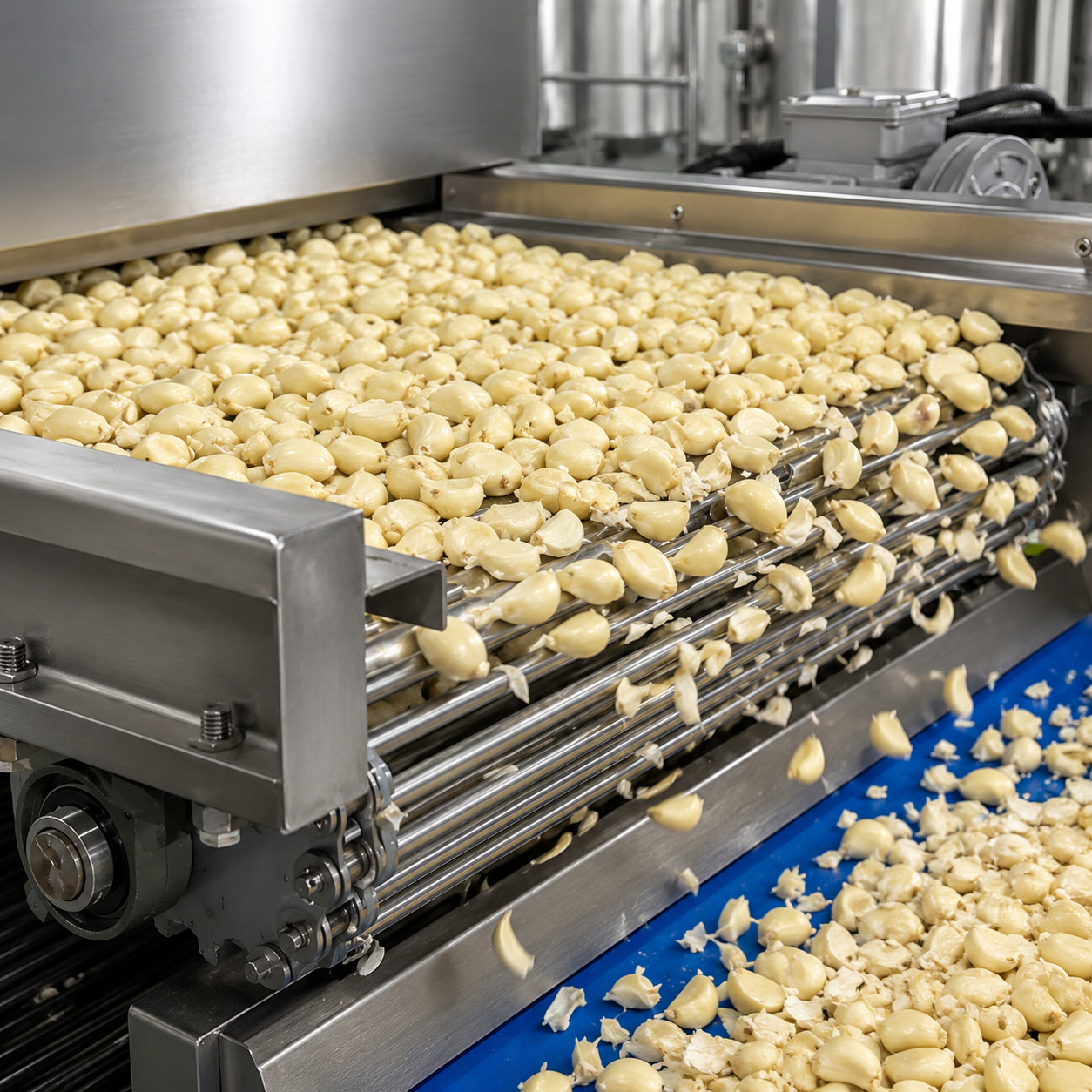
Dehydrated onion and garlic are among the most widely used savoury ingredients in industrial food production. They appear in seasoning blends, soups and sauces, snack coatings, processed meat, ready meals, marinades, and bakery applications, often quietly carrying most of the flavour load on the label.
Sourcing teams ask the same questions about them year after year. Which form belongs in which process? How does cut size affect rehydration and visible particle definition? What does a sensible specification look like, and what should a quality team verify before approving a lot? This article works through those questions in the language of formulation and buying, not marketing.
By the end, you should be able to read a dried allium specification with confidence, match the form to the application, and know what to ask a supplier about how the ingredient was made.
Key Takeaways
- Dehydration delivers a year-round, shelf-stable allium ingredient with a 5 percent moisture target.
- Cut and mesh size are chosen to match the process: powders for dispersion, granules for dry blends, kibbled cuts for visible texture, bold cuts for premium definition.
- Industrial onion runs all year; garlic runs February to April; both share the same packaging, microbiology, and certification footprint.
- A good specification names form, mesh range, package weight, target moisture, microbiological limits, and applicable certifications.
- Performance in your own process is best confirmed with a physical sample, not a spec sheet alone.
Why Allium Concentrates Earn Their Place in Industrial Recipes?
Fresh onion and garlic are seasonal, variable, and costly to store. The colour drifts, the sugars develop, the volatile aroma compounds change with field conditions, and the yield per kilogram of finished recipe is unpredictable. For an industrial line that has to deliver the same product week after week, that variability is a liability. Dehydration solves the problem by concentrating flavour into a stable, low-moisture format that ships and stores efficiently and behaves the same way in every batch.
The economics are also straightforward. A kilogram of dehydrated onion replaces somewhere between 5 and 10 kilograms of fresh onion, depending on the cultivar and the cut, and it does so without the cold-chain logistics, sorting waste, or labour overhead of handling fresh produce on the line. For a manufacturer running tens or hundreds of tonnes a week, that difference compounds.
Beyond cost and shelf life, dried alliums are also cleaner from a food-safety standpoint. They are produced to a documented microbiological specification, tested before release, and shipped in sealed packaging that protects them through transit and storage. A line that uses them inherits that discipline rather than having to build it themselves around fresh produce.
The Economics of Dehydration
The headline saving is weight. Drying removes roughly eighty to ninety percent of the water from fresh onion or garlic, which means a forty-foot container of dried product carries far more usable flavour than the same container of the fresh raw material. Shipping costs per finished kilogram drop accordingly, and the carbon footprint of a long-distance shipment improves alongside.
Shelf life is the second saving. Fresh produce demands cold chain or rapid turnover; dried allium with a 5 percent moisture target stored in proper conditions holds quality for many months. That predictability lets a purchasing team plan annual programmes instead of reacting week to week to crop conditions, weather, or freight markets.
Process savings are the third. A line that uses powdered or granulated allium can dose accurately by weight or volume, with no peeling, sorting, slicing, or refrigeration overhead. The handling cost per kilogram is lower, the QC overhead is lower, and the recipe is more reproducible.
Choosing The Right Cut For The Application
The right cut is the cut that suits the process. For a dehydrated allium, that means matching particle size to whether the ingredient is dispersed into a wet system, blended into a dry seasoning, used to deliver visible texture, or held as a recognisable garnish.
Powders
Powders are the finest grade, typically below 0.5 millimetres. They disperse instantly into wet systems such as marinades, brines, sauces, and beverages, and they integrate cleanly into dry seasoning blends without showing as discrete particles. Onion and garlic powder dominate spice blends, snack coatings, and ready-meal seasonings for that reason. The trade-off is appearance: a powdered finish reads as background flavour rather than visible inclusion.
Granules
Granules sit between powder and the larger cuts, typically in the one to 4 millimetre range. They are the workhorse format for industrial blending: small enough to disperse well, large enough to hold definition in the finished product. Granulated onion and garlic are common in dry rubs, sausage seasonings, instant soups, and recipe mixes where the buyer wants a slight visible texture without committing to full flake or kibble.
Minced and Chopped
Minced and chopped grades step up the visible particle size into the 4 to 8 millimetre range, with chopped slightly larger. They suit cooked applications such as soups, sauces, marinades, processed meat, and ready meals where the ingredient is meant to be seen and to contribute to bite as well as flavour. Rehydration is fast in cooked products because the heat and the surrounding moisture handle the work.
Kibbled and Sliced
Kibbled cuts and sliced cuts are among the largest standard grades, with particle sizes typically ranging from approximately 8 millimetres and above. They are used where product visibility and texture are important to the final application, including artisan-style soups, premium ready meals, seasoning blends, and foodservice preparations. Sliced cuts, in particular, are valued for applications that require a natural, recognizable vegetable appearance, offering enhanced visual appeal and a more authentic, handcrafted presentation in the finished product.
Onion VS. Garlic in Formulation Work
Onion and garlic share many of the same forms, but they play different formulation roles. Onion is sweeter, broader, and milder, and carries more weight before its flavour starts to dominate. Industrial recipes often use it as a base note across soups, sauces, snacks, and ready meals. Onion is also year-round at Healthy Foods Egypt; the crop calendar covers it across the full agricultural year, which simplifies annual supply planning.
Garlic is sharper, more aromatic, and more volatile. A small inclusion changes the character of a blend, and overdosing it is easy. Garlic also has a shorter processing window. At Healthy Foods Egypt the garlic crop runs February through April, which is when the harvest, washing, drying, and packaging happen. A buyer planning an annual programme typically commits volumes against that window and then draws stock through the year against the agreed schedule.
Onion is the Comma in a Recipe. Garlic is the Punctuation that Ends a Sentence.
For a buyer, that translates into different dosing tolerances, different specifications, and different relationships with the seasonal calendar. Both ingredients ship under the same packaging and certification footprint, so the operational side stays consistent even when the recipe-side rules differ.
A Reference Table: Cut to Particle Size
- Powder (under 0.5 mm): dry blends, marinades, beverages.
- Granules, fine (0.5 to 1 mm): dry seasonings, instant systems.
- Granules (1 to 4 mm): rubs, soup mixes, recipe blends.
- Minced (4 to 6 mm): sauces, soups, processed meat.
- Chopped (6 to 8 mm): ready meals, marinades.
- Kibbled, normal (8 to 10 mm): garnish, premium soup, charcuterie.
- Kibbled, large or bold cut (10 mm and above): visible texture, premium recipes.
These ranges are typical industrial standards. Custom mesh sizes and cuts are produced to order against a defined specification.
How We Make Ours
At Healthy Foods Egypt, the dehydration line is built around a 3-stage belt dryer supplied by National Aeroglide. The line produces around 11 metric tons of dried product per day, and from the moment material leaves the dryer it is conveyed without the touch of human hands through to sealed packaging.
After drying, the product passes through screening, sieving, laser and colour sorting, manual sorting, and metal detection. Cutting and granulation lines bring the dried product to the specified particle size: cutting runs at around eighteen metric tons per day, granulation at 12, and milling at 15, depending on the grade. Food-contact surfaces across the whole line are stainless steel type 304, which is the standard for sanitary food machinery.
The way each grade is made is described in more detail on the production hub, with dehydration and cutting and granulation carrying the per-line specs. The way it is verified, from lab testing to documented release, sits on the quality hub.
What to Specify on the Purchase Order?
A good specification for dehydrated onion or garlic names 6 things:
- Form (powder, granules, minced, chopped, kibbled, slices, toasted variants).
- Mesh or cut size range with tolerance.
- Package weight and configuration (bag, pallet, container fill).
- Target moisture (typically 5 percent).
- Microbiological limits (see how to read a microbiological specification).
- Applicable certifications (ISO 22000, BRC Grade A, HACCP, FDA registration, HALAL, KOSHER, USDA Organic or EU Organic where relevant).
Without those 6 fields, 2 suppliers can quote against the same product description and ship materially different ingredients. With them, comparison is straightforward and audit is clean.
Buyers also tend to ask about country of origin, sterilisation method (relevant for herbs and spices more than alliums, but sometimes specified), and pesticide and heavy-metal compliance. All 4 of our product families are processed in Egypt to European Union legislation on pesticides and heavy metals, and the controls behind that statement are described on the quality hub.
Toasted Variants and When to Specify Them
Beyond the standard cuts, dehydrated onion and garlic are also produced as toasted grades. Toasting is a controlled thermal step after drying that develops Maillard-reaction flavours and shifts the colour from pale ivory toward warm gold or amber. Toasted kibbled, toasted chopped, toasted minced, and toasted powder grades are all part of our standard catalogue.
The case for specifying a toasted grade is straightforward. Certain applications benefit from a deeper, more caramelised allium note than the untoasted form can deliver. Premium soup garnishes, smoked-style seasoning blends, charcuterie applications, and the kind of roasted flavour profile that consumer packaging often promises all read better with a toasted ingredient than with a standard one. The toasted grades also hold their visible appearance better in dark sauces and gravies, where a pale ivory particle can disappear into the background.
Buyers planning to specify toasted should consider 3 things. First, the toasting step changes the colour and the flavour, so a recipe built around standard kibbled cannot simply be swapped to toasted kibbled without re-tasting. Second, toasted grades cost slightly more because of the additional process step. Third, toasted onion or garlic in a finished product should be declared as such on the consumer label where appropriate, because the visual and flavour difference is meaningful.
Country of Origin and the Egyptian Advantage
A specification line that buyers increasingly include on dehydrated-ingredient purchase orders is country of origin. The reason is partly traceability, knowing where the raw material was grown, and partly regulatory, since some destination markets give preferential treatment to certain origins under trade agreements.
For dehydrated allium and herb ingredients, Egypt has a long-standing position as a major producer. The climate and soil of Egypt's cultivation belt suit allium and herb crops, the growing season is long, and a mature processing industry around the Bayad Al Arab Industrial Zone supports year-round operations. Egyptian onion in particular has a flavour profile, colour, and dry-matter content that perform well under industrial dehydration, which is why a meaningful share of the world's industrial dehydrated onion supply originates here.
For American buyers, Egyptian ingredients can also benefit from the QIZ (Qualifying Industrial Zones) programme, an Egypt and United States trade arrangement that allows qualifying goods to enter the United States duty-free. The QIZ certification is one of the 13 active certifications on our certifications page; for cost-sensitive U.S. buyers it can meaningfully improve landed cost on eligible products.
European buyers benefit differently. Egyptian product can be supplied to USDA Organic, EU Organic (via CERES), and other certified-organic programmes when specified at the quotation stage. Combined with the European Union compliance on pesticides and heavy metals already standard across our catalogue, this allows European sourcing teams to source organically-certified Egyptian product without leaving their preferred compliance regime.
A Note on Availability VS. Capacity
A common point of confusion in early buyer conversations is the difference between availability and production capacity. Availability refers to whether a product family is being processed and shipped in a given month. Capacity refers to the annual or daily volume the production line can handle.
For dehydrated onion, availability is year-round, and the dehydration line can produce around 11 metric tons of dried product per day on a continuous schedule. For garlic and leek, availability is concentrated in the February to April crop window, but the same lines can be used after the harvest with material that was processed during the window. Annual sourcing programmes typically commit volumes during the available window and draw stock through the year against the agreed schedule.
This is the difference between a one-off purchase and a real supply relationship. The former depends on what is in stock today; the latter on planning capacity months ahead. The relationship side is where the value of a dedicated supplier emerges, because a buyer who has committed to an annual programme has visibility on what will be available, when it will be ready, and how it will be specified, all the way through the buying year.
Working With Us On a Specification
Most quotations open with a few standard questions on volume, cut size, target market, and certification scope. From there, the conversation typically moves to packaging configuration, container fill, and shipping schedule. Annual programmes build in a delivery cadence and lock pricing for the season; spot orders typically ship within a few weeks against current stock.
A regional sales lead will respond inside one business day with a referenced proposal. The proposal includes a draft specification with the 6 fields named above, a packaging configuration, and the certification scope applicable to your order. Reviewing it in detail before signing the contract is the simplest way to avoid surprises at incoming inspection later.
Further Reading
For more detail on the specifications themselves, our companion article how to read a microbiological specification walks through the limits a quality team reads first. The 14-step process flow describes how the ingredients are made, step by step. And the products hub lists every cut, mesh, and package weight we ship.
Bringing it Together
Dehydrated onion and garlic do their best work when the cut, the specification, and the supplier are all chosen with the process in mind. The cut is matched to the application, the specification names the variables that matter, and the supplier provides documented evidence rather than assurances. With those 3 in place, a formulation behaves the same way across years, suppliers, and seasons, and a sourcing team buys with confidence.
To evaluate our ingredients in your own process, request a sample of the form you intend to use. To open a quotation on volume, cut size, and certification scope, request a quote and a regional sales lead will respond within one business day.