Turning a fresh agricultural crop into a stable, certified industrial ingredient is not a single operation. It is a chain of monitored steps, each one a checkpoint for quality, traceability, and food safety. At Healthy Foods Egypt the chain runs through 14 steps from field-side sourcing to export and distribution, and every batch of every product traverses the same documented sequence.
The flow is not a marketing story; it is the operating specification of the plant. Each step has its own equipment, its own controls, and its own contribution to the finished product. The 14 steps are listed below in order, with the equipment, the controls, and the sourcing audit points called out so a buyer reading this article can map it to their own audit checklist.
Key Takeaways
- Every batch traverses 14 monitored steps from agricultural sourcing to export.
- Food-contact surfaces are stainless steel type 304 throughout, the standard for sanitary food machinery.
- Metal detection is held to defined thresholds: ferrous 0.8 millimetres, non-ferrous 1.1 millimetres, stainless steel 1.2 millimetres, with a 12,000 gauss magnet.
- Equipment is sourced from named industrial vendors: National Aeroglide (dehydration) and Allagier of Germany (herbs and spices line).
- From dehydration through to sealed packaging, the product is conveyed without the touch of human hands.
Why a Single Flow Matters
Industrial buyers want consistency. The reason is straightforward: a recipe formulated around an ingredient that drifts from batch to batch becomes unpredictable, and an unpredictable ingredient creates an unpredictable finished product. The single most reliable way to deliver consistency is to put every batch through the same documented sequence, with the same controls, on the same equipment.
A documented flow is also what makes the supplier auditable. A buyer's quality team or a third-party auditor can ask which step controls a given hazard, verify it against the records, and form a view on whether the control is robust. A supplier that cannot describe the flow step by step usually cannot pass an audit.
The 14 steps below are the documented flow at Healthy Foods Egypt. They are the same 14 steps that appear in our about page, the same 14 steps on the production hub, and the same 14 steps named in our food-safety management system certified to ISO 22000.
Steps 1 to 3: Agricultural Sourcing to Washing
Step 1 is Agricultural Sourcing. Raw materials are grown in the cultivation areas of Egypt, close to the plant. Short transit between field and intake preserves freshness, reduces the energy cost of moving fresh produce, and keeps the agricultural relationship traceable from grower to finished lot. Annual sourcing programmes with growers, rather than spot purchasing, anchor the season-by-season commitments and the volumes we plan against.
Step 2 is Receiving and Inspection. Incoming raw materials are accepted only after a satisfactory quality report on intake. The inspection looks at variety, condition, moisture, foreign material, and any visible damage. Lots that fail intake do not enter the plant; lots that pass are recorded and queued for processing.
Step 3 is Washing and Preparation. The raw material is washed with pure tap water without additives, and prepared mechanically for the dehydration line. The wash removes surface soil and dust; the preparation handles trim, peel, or sort steps that are specific to each product family.
Steps 4 to 6: Air Separation, Screening & Colour Sorting
Step 4 is Air Separation. A controlled air stream removes light foreign material (chaff, leaves, dust, light contaminants) by density. This step is the first opportunity to remove material that the wash did not catch.
Step 5 is Screening and Sieving. Mechanical screens grade the product by size and remove any oversize or undersize material that does not match the target cut. The screens are food-grade stainless steel, and the screening pattern depends on the form being produced (powder, granules, kibbled, bold cut).
Step 6 is Laser and Colour Sorting. Optical sorting equipment removes off-colour material, dark specks, and any visible foreign objects that survived earlier stages. The threshold is set against the product specification, and the rejected stream is captured for waste handling separately.
Steps 7 and 8: Manual Sorting and Detal detection
Step 7 is Manual Sorting. Trained operators inspect the product line visually as a final check before metal detection. The role of manual sorting is to catch anything the optical sorter cannot resolve, which in practice is rare but not impossible.
Step 8 is Metal Detection. 2 technologies sit at this stage: a metal-detection system with defined rejection thresholds, and a powerful magnet that removes ferrous fragments by attraction. The thresholds and magnet strength are set as follows:
- Ferrous Fragments: rejected at 0.8 millimetres.
- Non-ferrous Fragments: rejected at 1.1 millimetres.
- Stainless Steel Fragments: rejected at 1.2 millimetres.
- Magnet Strength: 12,000 gauss, removing ferrous fragments by attraction.
These are tight thresholds by industry standard, and they are validated against test pieces of known size at the start of every shift. The combination of metal detection plus a powerful magnet is what makes foreign-body control measurable rather than asserted.
Steps 9 and 10: Granulation and Milling
Step 9 is Granulation. After the safety steps, the dried product passes through dedicated granulation equipment that brings it to the specified particle size for granular grades. The granulation line at Healthy Foods Egypt runs at around 12 metric tons per day across the catalogue.
Step 10 is Milling. Milling produces the finer grades (powder, fine granules) on a separate line. The milling line runs at around 15 metric tons per day, and includes a cooling stage that prevents thermal damage to flavour and colour compounds during reduction. Cutting (which sits earlier in the flow for some products) runs at around eighteen metric tons per day; the herbs and spices line runs at around 8 metric tons per day with sieving and separation equipment from Allagier of Germany.
Steps 11 and 12: Packaging and Warehousing
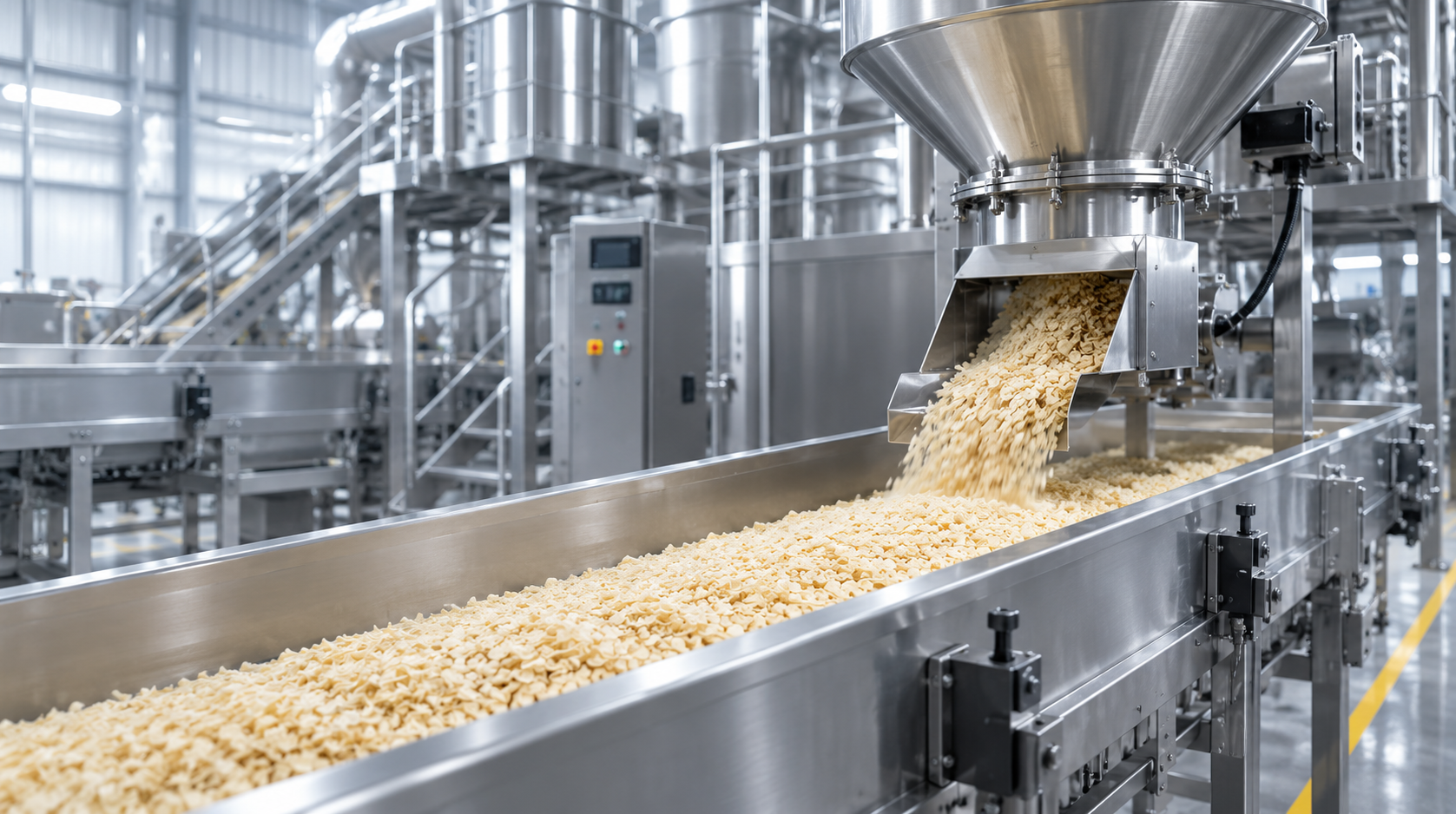
Step 11 is Packaging. The finished product moves directly to the packaging line, where it is sealed into the double-bag system described in packaging and pallet discipline for shelf life. From the moment the product leaves the dehydration line through to sealed packaging, it is conveyed without the touch of human hands. That continuity is the reason the microbiological profile of the finished pack matches the profile measured at the dryer exit.
Step 12 is Warehousing. Sealed packs are moved to the 11,000 square metre warehouse, held at or below 65 percent humidity with controlled climate and air recycling, and held on plastic pallets above the floor. Pallets are bar-coded, and the bar-coding system tracks every pallet from packaging through to dispatch, with daily inventory reconciliation against the production records.
Steps 13 and 14: Laboratory Testing and Export
Step 13 is Laboratory Testing. Every lot is sampled and tested by our in-house laboratory before release, with cross-validation by an accredited external laboratory. The tests measure particle size, bulk density, total moisture, water activity, microbiological load, pesticide residues, heavy metals, and cleanliness. The pass criteria are the product specification; lots that fail are held back from release until the issue is resolved.
Step 14 is Export and Distribution. Released product is loaded into containers in patterns optimised for the destination, with full documentation: certificate of analysis, certification copies, packing list, and any market-specific declarations. The bar-coding system records the loading sequence, which becomes the basis of the packing list and the bill of lading.
Equipment Vendors and the Stainless-Steel rule
2 named industrial vendors anchor the equipment side of the flow. The dehydration line is built around a 3-stage belt dryer supplied by National Aeroglide, which produces around 11 metric tons of dried product per day. The herbs and spices line uses sieving, separation, gravity-sorting, and metal-detection equipment from Allagier of Germany.
Across the whole plant, food-contact surfaces are stainless steel type 304. This is the standard for sanitary food machinery: corrosion-resistant, easy to clean, compatible with the cleaning chemistries used in food production, and the default specification for any audit-passing food line. The choice of named vendors and the stainless-steel rule are deliberate, because they give a buyer something concrete to audit.
What a Buyer Audits at Each Step
A sourcing or quality team auditing this flow against their own standard would typically ask the following at each major step:
- Step 1-2 (sourcing, receiving): variety records, intake inspection sheets, supplier qualification programmes.
- Step 3 (washing): water quality records, cleaning chemistry, validation of removal of soil and dust.
- Step 4-6 (separation, screening, optical sorting): equipment calibration, threshold validation, rejection-stream handling.
- Step 7-8 (manual sorting, metal detection): operator training, test-piece validation at shift start, rejection-stream destination.
- Step 9-10 (granulation, milling): particle-size validation against specification, cooling controls, dust handling.
- Step 11-12 (packaging, warehousing): seal validation, pallet labelling, warehouse climate records.
- Step 13-14 (lab, export): in-house lab method validation, external lab accreditation, release-criteria documentation, packing-list accuracy.
A supplier that can answer cleanly across all 7 groups is a supplier whose process is genuinely auditable. The 14-step flow at Healthy Foods Egypt is built to support exactly that level of audit, which is why the flow is described in detail rather than hidden behind marketing copy.
Throughput In Numbers
Each line in the plant has a documented daily throughput. The numbers anchor capacity planning for annual supply programmes and let buyers calibrate the realistic order sizes a single supplier can ship.
- Dehydration (3-stage belt dryer, National Aeroglide): around 11 metric tons of finished dried product per day.
- Cutting: around 18 metric tons per day, producing bold cut, kibbled, and sliced grades.
- Granulation: around 12 metric tons per day, producing granular grades.
- Milling (with cooling stage): around 15 metric tons per day, producing powder and fine granules.
- Herbs and spices (sieving, separation, gravity sort, and metal detection, Allagier of Germany): around 8 metric tons per day.
Daily throughput is the right number for short-window orders; annual capacity is the right number for long-term programmes. The annual figures align with per-product catalogue commitments and are confirmed at the quotation stage. The figures also help buyers plan inbound logistics: a sourcing programme that draws a fixed monthly volume from a single supplier should sit comfortably below daily throughput so that production schedules absorb normal variation in order timing without straining capacity.
Cross-Contamination Control and Dedicated Lines
A common audit question on a multi-product food plant is how cross-contamination between products is prevented. At Healthy Foods Egypt the answer is structural: the 3 production lines (dehydration, cutting and granulation, herbs and spices processing) are physically separated rather than time-shared on common equipment.
Dedicated lines mean that alliums (onion, garlic, leek) never share equipment with herbs and aromatic seeds, and within the dehydration line itself the schedule is sequenced to minimise carry-over between product families. Cleaning between product runs follows a documented schedule with validation; the schedule and the validation evidence form part of the audit pack supplied to buyers on request.
The structural choice has a sourcing implication: it makes specifying allergen-free, religion-compliant, or certification-restricted product easier, because a dedicated production environment is by design less likely to cross-contaminate. It is one of the reasons our HALAL and KOSHER certifications are held at the facility level rather than at the per-product level.
How The Flow Maps To Certifications
Each step in the 14-step flow contributes to one or more of the active certifications on our certifications page. The mapping is not abstract: a certification auditor walking the line can trace each control to a step, each step to a record, and each record to a release decision.
ISO 22000, the food-safety management standard, is anchored by HACCP analysis of the whole flow with critical control points typically at metal detection, lab testing, and packaging. ISO 9001, the quality-management standard, is anchored by the procedures and records that govern every step. ISO 14001 anchors the environmental controls (water, energy, waste handling) that wrap around the steps. BRC Grade A requires food-safety controls similar to ISO 22000 but with an additional retail-facing audit standard layered on top. FDA registration, HALAL, and KOSHER certifications are applied at the facility level and verified against the same flow.
The point of a documented flow is that the certifications are not separate from operations. They describe what operations actually do, in a language an auditor can verify, and the flow chart is the bridge between the daily work and the certificate framed on the wall.
The People Behind The flow
A documented process is only as reliable as the people who operate it. Healthy Foods Egypt employs more than 350 professionals across the Beni Suef plant and the Cairo head office, organised into production, quality, engineering, and commercial teams. Each role on the production floor is defined by a documented competency profile, with training records that follow the operator through their career on the line.
Quality assurance, hygiene-and-quality-control, and laboratory teams maintain the verification chain and the audit-readiness of the operation. Engineering teams maintain the equipment to manufacturer specifications and run the preventive-maintenance schedule that keeps the lines reliable. Production teams run the lines themselves, with supervisors holding the documented release authority at each shift handover.
The retention rate at Healthy Foods Egypt is one of the things buyers consistently comment on after a plant visit. Many of the colleagues on the production floor have been with the business for a decade or more, which means the operating knowledge of the lines runs deep. A new buyer audit is generally handled by the same operators who have been running the line for the previous several years; questions get answered first-hand, not relayed up a chain of management.
The training programmes that sit behind the operating roles are described in the documentation submitted at audit. Sourcing and quality teams visiting the plant typically meet the relevant operators directly and ask questions of them, not just of the management team. The fact that this conversation works at the level of detail buyers want is one of the reasons new buyer-supplier relationships convert into long-running annual programmes, rather than one-off transactions.
Further Reading
For the microbiological commitment that the flow protects, see how to read a microbiological specification. For the packaging system that carries the product after the flow, see packaging and pallet discipline for shelf life. For the day-to-day quality programme that wraps the flow, see the quality hub.
Bringing it Together
The 14-step process flow is not a marketing story; it is the operating specification of the plant. Each step has its own equipment, its own controls, and its own auditable contribution to the finished product. From agricultural sourcing in Egypt through to export-ready container loading, every batch traverses the same sequence with the same documentation and the same release criteria.
To open a quotation with the form, volume, certification scope, and target market specified, request a quote and a regional sales lead will respond within one business day. To audit the flow in person, contact us and we will arrange a plant visit at the Beni Suef facility.